【python】sort函数的时间+空间复杂度(包括py内置.sort())
python有个内置的nums.sort()排序函数,其内部实现机制为:Timesort
最坏时间复杂度为:O(n log n)
空间复杂度为:O(n)
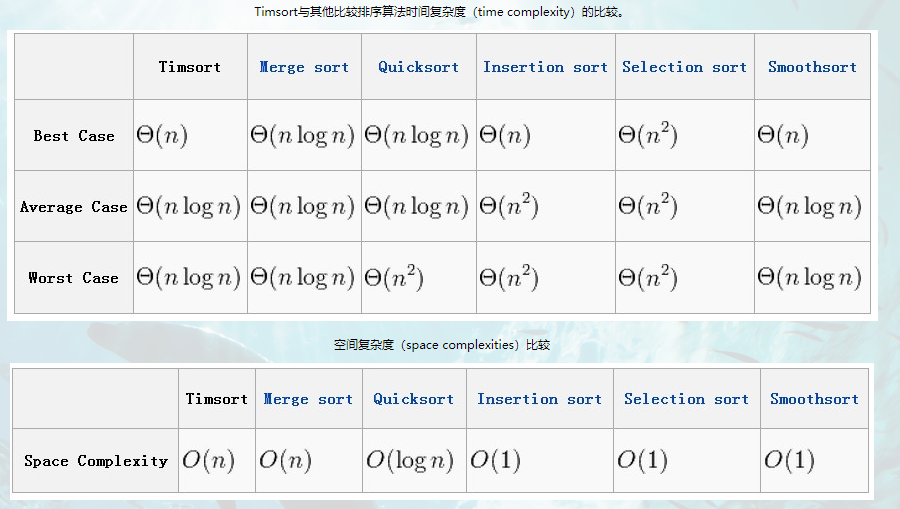
顺便整理一下其他的各种排序算法:

| 排序算法 | 平均时间复杂度 | 最好情况 | 最坏情况 | 空间复杂度 | 排序方式 | 稳定性 |
|---|---|---|---|---|---|---|
| 插入排序 | O(n²) | O(n) | O(n²) | O(1) | In-place | 稳定 |
| 冒泡排序 | O(n²) | O(n) | O(n²) | O(1) | In-place | 稳定 |
| 选择排序 | O(n²) | O(n²) | O(n²) | O(1) | In-place | 不稳定 |
| 快速排序 | O(n log n) | O(n log n) | O(n²) | O(log n) | In-place | 不稳定 |
| 希尔排序 | O(n log n) | O(n log n) | O(n log n) | O(1) | In-place | 不稳定 |
| 堆排序 | O(n log n) | O(n log n) | O(n log n) | O(1) | In-place | 不稳定 |
| 归并排序 | O(n log n) | O(n log n) | O(n log n) | O(n) | Out-place | 稳定 |
直接插入排序:
def insert_sort(array):
    for i in range(len(array)):
        for j in range(i):
            if array[i] < array[j]:
                array.insert(j, array.pop(i))
                break
    return array
希尔排序:
def shell_sort(array):
    gap = len(array)
    while gap > 1:
        gap = gap // 2
        for i in range(gap, len(array)):
            for j in range(i % gap, i, gap):
                if array[i] < array[j]:
                    array[i], array[j] = array[j], array[i]
    return array
选择排序:
def select_sort(array):
    for i in range(len(array)):
        x = i  # min index
        for j in range(i, len(array)):
            if array[j] < array[x]:
                x = j
        array[i], array[x] = array[x], array[i]
    return array
堆排序:
def heap_sort(nums):
    # 调整堆
    # 迭代写法
    def adjust_heap(nums, startpos, endpos):
        newitem = nums[startpos]
        pos = startpos
        childpos = pos * 2 + 1
        while childpos < endpos:
            rightpos = childpos + 1
            if rightpos < endpos and nums[rightpos] >= nums[childpos]:
                childpos = rightpos
            if newitem < nums[childpos]:
                nums[pos] = nums[childpos]
                pos = childpos
                childpos = pos * 2 + 1
            else:
                break
        nums[pos] = newitem

    # 递归写法
    def adjust_heap(nums, startpos, endpos):
        pos = startpos
        chilidpos = pos * 2 + 1
        if chilidpos < endpos:
            rightpos = chilidpos + 1
            if rightpos < endpos and nums[rightpos] > nums[chilidpos]:
                chilidpos = rightpos
            if nums[chilidpos] > nums[pos]:
                nums[pos], nums[chilidpos] = nums[chilidpos], nums[pos]
                adjust_heap(nums, pos, endpos)
def heap_sort(array):
    def heap_adjust(parent):
        child = 2 * parent + 1  # left child
        while child < len(heap):
            if child + 1 < len(heap):
                if heap[child + 1] > heap[child]:
                    child += 1  # right child
            if heap[parent] >= heap[child]:
                break
            heap[parent], heap[child] = \
                heap[child], heap[parent]
            parent, child = child, 2 * child + 1

    heap, array = array.copy(), []
    for i in range(len(heap) // 2, -1, -1):
        heap_adjust(i)
    while len(heap) != 0:
        heap[0], heap[-1] = heap[-1], heap[0]
        array.insert(0, heap.pop())
        heap_adjust(0)
    return array
冒泡排序:
def bubble_sort(array):
    for i in range(len(array)):
        for j in range(i, len(array)):
            if array[i] > array[j]:
                array[i], array[j] = array[j], array[i]
    return array
快速排序:
def Quick_sort(num_list):
    '''
    快速排序,时间复杂度:O(nlog₂n),空间复杂度:O(nlog₂n),不是稳定排序
    '''
    if len(num_list)<2:
        return num_list
    left_list = []  #存放比基准结点小的元素
    right_list = []  #存放比基准元素大的元素
    base_node = num_list.pop(0) #在这里采用pop()方法的原因就是需要移除这个基准结点,并且赋值给base_node这个变量
                                #在这里不能使用del()方法,因为删除之后无法再赋值给其他变量使用,导致最终数据缺失
                                #快排每轮可以确定一个元素的位置,之后递归地对两边的元素进行排序
    for one_num in num_list:
        if one_num < base_node:
            left_list.append(one_num)
        else:
            right_list.append(one_num)
    return Quick_sort(left_list) + [base_node] + Quick_sort(right_list)
归并排序:
def merge_sort(nums):
    if len(nums) <= 1:
        return nums
    mid = len(nums) // 2
    # 分
    left = merge_sort(nums[:mid])
    right = merge_sort(nums[mid:])
    # 合并
    return merge(left, right)

def merge(left, right):
    res = []
    i = 0
    j = 0
    while i < len(left) and j < len(right):
        if left[i] <= right[j]:
            res.append(left[i])
            i += 1
        else:
            res.append(right[j])
            j += 1
    res += left[i:]
    res += right[j:]
    return res
基数排序:
def radix_sort(array):
    bucket, digit = [[]], 0
    while len(bucket[0]) != len(array):
        bucket = [[], [], [], [], [], [], [], [], [], []]
        for i in range(len(array)):
            num = (array[i] // 10 ** digit) % 10
            bucket[num].append(array[i])
        array.clear()
        for i in range(len(bucket)):
            array += bucket[i]
        digit += 1
    return array
参考大佬整理内容,附链接: